 FACULTY OF EXACT AND NATURAL SCIENCES
 FACULTY OF HUMANITIES
 FACULTY OF SOCIAL AND POLITICAL SCIENCES
 FACULTY OF PSYCHOLOGY AND EDUCATIONAL SCIENCES
 FACULTY OF ECONOMICS AND BUSINESS
 FACULTY OF MEDICINE
 FACULTY OF LAW




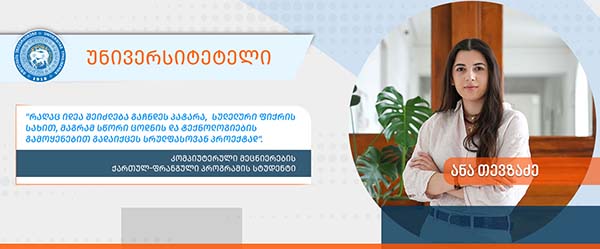 The hero of today’s University Graduate column is Ana Tevzadze, a bachelor’s student in the Georgian-French Computer Science program at Tbilisi State University’ Faculty of Exact and Natural Sciences. Despite her young age, she is already working on implementing quite interesting ideas.
Upon completing the Georgian-French Computer Science program, Ana will hold a double bachelor’s degree from Évry Val d'Essonne University and TSU.
The TSU bachelor's degree program in computer science is four years long. The first three years (equivalent to 180 ECTS) are conducted at TSU, with lecturers from the TSU academic staff. The fourth year (60 ECTS at TSU) is implemented jointly by TSU and the University of Évry. Upon completion of the program, graduates receive a double diploma: TSU bachelor’s degree in computer science and Évry Val d’Essonne bachelor’s degree in informatics.
The TSU program includes the opportunity to teach a number of subjects in French. Lectures are provided in French by the partner university. Students have the option to study in English within the framework of the English-language bachelor’s program.
Ana Tevzadze tells us why she chose this program and how satisfied she is with her decision.
Specialization as a means to implement ideas
“Choosing a specialty was not difficult for me, because I have always been interested in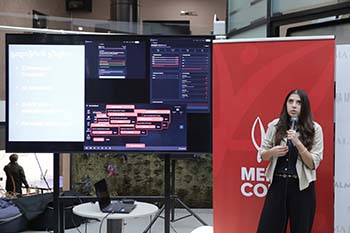 technology and its ability to change the world. Computer science now gives me the opportunity to create these changes myself.
I am happy with my choice. I love coming up with original and creative ideas, and to me, computer science is the space where these ideas are transformed into real products and solutions. For instance, an idea may begin as a small, seemingly insignificant thought, but with the right knowledge and technology, it can evolve into a substantial project. I often think ideas are born from the simplest, everyday problems. Once, for instance, my alarm clock failed to wake me up before an important exam, so I could not prepare properly. This experience was quite stressful, and it led me to explore the question: How do human sleep cycles affect awakening? How does the brain respond to various audio stimulus, and how can a combination of these factors be used optimally?
The idea is to create a personalized system that uses human behavior and sleep data to determine the optimal wake-up time. The system uses an adaptive sound signal (frequency, intensity, rhythm) to make waking up more productive and less stressful. Currently, I am working on the conceptual and algorithmic aspects of this idea. I am especially interested in the process by which an everyday problem becomes a research topic and then a potential technological solution.
This process is the most interesting to me because I often learn new things and grow during this time. I am attracted to this field because creativity and logic work together, and you have the freedom to create something new that will have a real impact on people’s daily lives.
Many of my friends thought that the Georgian-French computer science program required prior knowledge of French, which is why they avoided it. They later regretted their decision because, in fact, the university teaches French from scratch. Therefore, I advise you to take this into account and not miss out on this unique opportunity. I highly recommend this program to anyone interested in technology, innovation and development. The program provides a strong academic foundation and international experience.
Computer Science - Perspectives for a Career and a Free Life
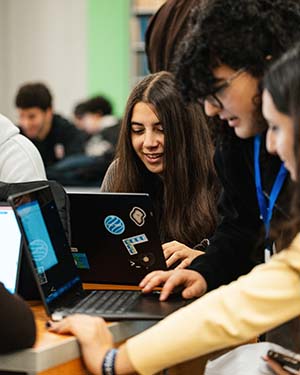 Computer science may seem difficult at first, but it is a very interesting and dynamic field. The key is to practice constantly, be curious and approach problems in new ways. Another great advantage of this field is that you can work from anywhere in the world. This is very important to me personally because I dream of traveling, getting to know different cultures and finding new inspiration. I do not want to live in a monotonous environment. In the future, I want to contribute to the development of my country with the knowledge and experience I have accumulated. Computer science provides not only a promising career, but also freedom and a diverse life.
I am studying French intensively through the program, currently taking the B1-level course. We are taught by French and Georgian lecturers, which makes the learning experience more diverse and effective.
In addition to French, I speak English, Russian, and German. Being multilingual significantly helps me integrate into and communicate in an international environment.
In early February 2026, I participated in an international conference in Milan with the funding of TSU, where I presented a report on the topic: “Education and Learning with Artificial Intelligence.” This experience was very important to me. I had the opportunity to meet with representatives from different countries, share ideas, and hear different perspectives. Such an environment provides a better understanding of how quickly technologies are developing and the many new opportunities that exist. Not only did the university fund my participation, but it also gave me the knowledge and confidence to present my ideas in front of an international audience. The visit proved fruitful. I returned with new knowledge, experience, and motivation that will be an important foundation for my future academic and professional development.
A few days ago, I participated in the BR41N.IO (http://BR41N.IO) Spring School 2026 international hackathon. Although I did not know anyone there, that was the most interesting part because I met people of different nationalities, learned a lot, and we started working on projects with a positive charge. Our project is called NeuroBeat, a system that controls music with brain signals. The concept is straightforward: an individual undergoes an electroencephalogram (EEG), and their brain activity and facial movements are instantly transformed into musical effects. In other words, a person controls the music like a DJ, but without using their hands - only their brain. As simple as the idea sounds, it was difficult to bring it to life. Technically, EEG technology reads electrical signals from the brain and sends the data to a program, where it is filtered and processed. The system detects simple actions, such as eye blinks or jaw movements (which are actually EMG artifacts; however, we intentionally use them as control signals). These signals are then converted into commands and sent to Ableton Live, which manipulates the music by changing effects. Thus, the user can effectively control the music hands-free.
In the future, I would like to continue my studies in Europe and further expand my knowledge of technology. In terms of employment, I would like to work for an international company that would give me the opportunity to work from both Georgia and other parts of the world. I know achieving this freedom will require a lot of hard work, but difficulties motivate me, not discourage me. That is why I will not stop. I want to constantly develop and create valuable things.
I believe the demand for computer science specialists will remain high in the future, particularly in areas such as artificial intelligence, data analysis, and cybersecurity. Although there is growing competition today and one may face some difficulties initially, the great advantage of this field is that new directions and opportunities are constantly emerging. I believe that if I continue to develop my skills, gain practical experience, and master new technologies, I will be in demand in both the local and international markets.
A few words about future plans...
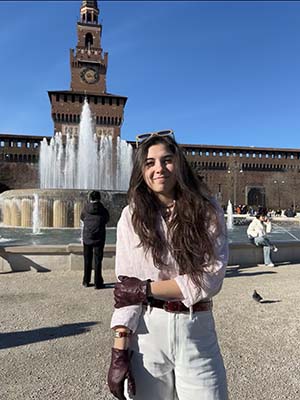 The field of technology is so broad that, before choosing a specific career path, I want to explore different areas and develop my skills in many ways. TSU provides a great opportunity for that. I have taken various courses, such as FPV drone engineering, innovative entrepreneurship, neural networks, blockchain technologies and decentralized applications, and I am still studying them. I took these courses at Tbilisi State University through the TSU Knowledge Transfer and Innovation Center. I have also taken various educational courses on other platforms, such as TBC Techschool, TBC IT Campus, and GeoLab.
I actively participate in technology meetings and hackathons, where I have gained significant experience and achieved notable results. For instance, in the TSU AI pre-acceleration program, our team was among the top five for a smart glasses project that simplifies the daily lives of visually impaired individuals. As part of the project, we developed software and an artificial intelligence model that recognizes objects and text, providing users with relevant information. Thanks to TSU, I am currently working on various interesting projects and gaining valuable practical experience. Currently, we are developing artificial intelligence agents that manage financial processes in decentralized systems.
For me, student life is not only a process of learning, but also of self-discovery and development. I am glad to be on this path, and I am looking forward to future opportunities.
Currently, my work includes academic and practical projects. I participate in hackathons and pre-acceleration programs, where we develop technological products together with our team. Simultaneously, I work as an AI Research Trainee at HIGGS, where we develop artificial intelligence models and agents, including projects related to decentralized finance. My role includes research, idea development, and participating in technical implementation.